Saturday, June 8, 2013

Patch Town Days at Eckley Miners' Village

PATCH TOWN DAYS

Saturday & Sunday - 

June 15 & 16

10am - 5pm both days


Eckley Miners' Village should have been a ghost town in the mountains of northeastern Pennsylvania, but a series of miracles happened.


Movie Town


In the late 1960s, Paramount Pictures thought this would be a great location to film "The Molly Maquires" starring Sean Connery, Richard Harris and Samantha Eggar.

Eckley had hardly changed since the mid-1800s. The buildings represented a typical "company town" of the Anthracite Mining region of Pennsylvania. It looked the part that was needed for the movie's era and locale, where families really lived.

With an 11 million dollar budget, Paramount was able to restore Eckley, Pennsylvania, including moving the electric wiring underground and pulling off post 1870s features, such as TV antennas.

Paramount constructed a large coal breaker near the middle of the town to provide a background that established the town's mining status.  They also constructed a series of mining cars. They are four-wheeled cars with link and pin couplers and hand brakes. Many of these cars still exist, though some of them are badly deteriorated.

Preservation


The Pennsylvania Historical and Museum Commission took this treasure town and preserved it by turning it into a large living history mining museum. Creative financing has helped to preserve this wonderful town. Living historians - and other residents - can actually live here by paying rent and agreeing to a strict set of rules that preserves the historical character of the village. The cars that you see on the streets are antiques. The facades present a company town appearance.


An Annual Event


Patch Town Days are held annually on the third weekend in June. In 2013, the event will be on the 15th and 16th of June.

Kent Courtney Live


Kent Courtney will be making personal appearances with performances of historical music on both days of the event. He will be singing a mix of union organizing songs, railroad songs, mining songs and Irish songs.


His stories will include the struggles that lead to the formation of the United Mine Workers - including some interesting facts about the fabrication of events surrounding the Molly Maguires. In his research, he has discovered a connection between the mine owners' persecution of their own workers in Pennsylvania and the mine owners in Colorado. Their tactics - and the pawns of the mine owners - were the same.

Living Historians


There are a lot of things to do during Patch Town Days at Eckley Miners' Village. Many different occupations are represented by knowledgeable actors who portray the lifestyles of people in the anthracite patch in the 1800s and early 1900s.

You can watch girls washing clothes and see food being cooked over a campfire. There's a policeman, fancy gentlemen, ladies and many mine workers are portrayed.  Eckley Miners' Village truly comes to life.

Blacksmithing


Two working blacksmiths will provide continuing demonstrations at the Blacksmith shop where visitors can watch the fabrication of iron tools in a forge typical of the type used in mining areas. Specialized tools were required to drill holes for blasting in the mines with the hand-powered drilling methods used to create the holes where dynamite would be inserted to open up coal seams.

Single and Double Jacking


Small hand drills looked like chisels when driven and hammered by one person - single jacking.  Double jacking drills were longer, being used by a two person team.  In double jacking one person would hold a bit and twist it as another used a large sledge-like hammer to create the holes for the dynamite.  Both of these styles of bits wore out quickly while being hammered into the coal and rock. So, the blacksmiths were constantly busy sharpening bits and creating new ones.

Railroads


Without the railroads, the coal business could not have developed the industry associated with the nearly smokeless anthracite. In the 1870s, the four-wheeled train cars used to haul coal were called "jimmies". These short cars are represented by the left-over props from Paramount's movie, "The Molly Maquires".

Modeling the Miners' Village


There are many details to be found in this living history village that offer model railroaders a chance to look at an earlier period's lifestyle that can be translated into accurate scenes on a train layout.  The Molly Maguires was nominated for an Academy Award for Best Art Direction, so the source for this look has won critical acclaim. It's always good to look for "best examples" when choosing prototype scenery.


Sunday, June 2, 2013

First Excursion of Steam Into History 2JUN13

The weather was beautiful for the start of the Civil War steam train excursions out of New Freedom, PA. This would be just another photograph except for a chance inclusion of Debi Dwyer Beshore in the left background. As usual, she is busy on the cellphone, coordinating a dozen things at a time in her role as Manager of Steam Into History.
 Somehow, this looks like a scene out of The Waltons with Kent talking to the Fireman of the "York", number 17 of the Northern Central Railway - pictured in the background.
 For the start-up celebration, Kent provided the PA system, and of course sang some of his favorite Civil War and railroad songs, while telling the story of the Northern Central Railway. That guitar amp at the lower left of this photograph is a Peavey Austin 400, Kent's favorite guitar amp.
 There she is, the "York" under steam and smoking up a storm as she heads toward Glen Rock, Pennsylvania.
Today's excursion was sold out and there were many people who couldn't get a ticket. Because of the popularity of this Civil War train ride, it is suggested that you get tickets online at http://www.steamintohistory.org

Monday, May 27, 2013

Gilbert's Hobbies in Gettysburg, Pennsylvania

This is an HO scale Railroad Station model at Gilbert's Hobbies in Gettysburg, PA.  If you are coming to Gettysburg during the 150th Anniversary year, you want to visit this fine hobby shop that has a wide selection of various hobby items, focusing on model railroading in HO, HOn3 and N scales.  They also have pre-painted Civil War miniature figures.  Their mobile-ready web site is: http://www.gettysburghobbies.com
  

Monday, May 20, 2013

Tracks in New Freedom, PA

The headquarters building of Steam Into History is in New Freedom, PA at 2 West Main Street. The building is right next to the York County Rail Trail and the tracks that they will be using to run the Civil War steam train excursions. Steam Into History will be using an American-type, 4-4-0, which is a reproduction of a typical Civil War steam locomotive. http://www.steamintohistory.org
Last week, the trucks arrived for the passenger cars that will be used for the first phase of the steam train operation. They are a derivative of the journal box, Bettendorf T-Section trucks. They look a lot like the Pennsylvania Railroad Class 2D-F8 50-ton freight. The bolster might have been replaced, which makes positive identification questionable. The actual 2D-F8 had a riveted bolster.  It's not unusual to have train equipment with mixed lineage.

The journal boxes contain oily rags that serve as lubrication for the end pins of the wheel to rotate within. The journal boxes are at the end of the cast frame, which resembles a "T".  The cast frame has springs that support the bolster. This sprung support cushions the ride, much like a rubber tire cushions the ride of wheels used on a bicycle or automobile. The bolster of the truck supports the railroad car above it by attaching to the underframe of the car. Usually, this is done by means of a pin that goes into a hole in the bolster of the truck. On a real train, the weight of the car holds the truck in place. On model railroads a screw or snap keeps the truck attached to the underside of the railroad car.
This is the view from Main Street in New Freedom, PA looking north with the York County Rail Trail and the Steam Into History Headquarters on the right.
Looking south from Main Street in New Freedom, PA, the York County Rail Trail is on the left. The New Freedom Trains station is also on the left. It contains the Rail Cafe (a great place to eat), a museum and nice restrooms (that's a real plus).

Note that the ballast is not only multi-colored, but it also has a variety of sizes of ballast. Modelers should remember that ballast is rarely one uniform color.  Looking at color photographs of railroads in the 1950s, it amazes me how there was such variety of ballast on one section of rail line.  Repairs and adjustments might be made at different times using ballast from different quarries or sources.


Sunday, May 19, 2013

Raid on the Northern Central Railway - Scenes filmed 11MAY13

On Saturday, 11 May 2013, reenactors and civilian actors gathered to film a re-creation of the Confederate raid on the Northern Central Railroad station of June 1863. Rain was predicted all day, but it held off until the shoot was finished. Scenes included civilians at the station and the telegrapher.  The telegrapher was captured by the Confederates to prevent him from warning other stations along the line. 

In this photo, the civilians are being briefed about their parts in the film. On the far right, seated on the bench, is John Riggle. John, who is an Executive Producer of the film was General Manager of two television station, including WPMT, FOX Channel 43 (Harrisburg, Lebanon, Lancaster, PA). http://www.riggplus.com

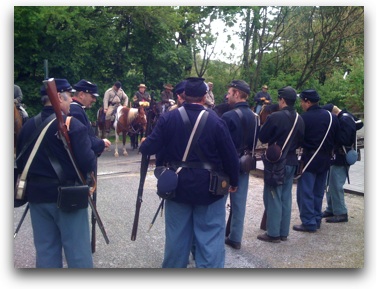
While the civilians were going through their roles, the Confederate Cavalry and the Pennsylvania Militia line up for their safety instructions and roll-call. Facing each other for this line up presaged the skirmish activity that was to be filmed later on.

The Pennsylvania Militia moved their line over to the southern grounds of Hanover Junction Station. They "stacked arms" so that they could pull them apart for the filming. I am portraying an Assistant Surgeon of the Pennsylvania Militia. Assistant Surgeon is the rank of an entry-level doctor that would be assigned to tend to the needs of the troops.

On my right, I am carrying a medical haversack, that contains various medicines, bandages, tourniquets and a triage kit. In the case of a wound that cause a bone to be shattered, the tourniquet would control venous and arterial circulation to an extremity while the wounded soldier would be transported to the rear.

On my left is an over-sized, kidney-shaped tin canteen that would carry enough water to minister to the needs of the wounded - as well as myself.  Below the canteen is an officer's haversack containing three days rations (food) for me to eat while on the march.  A plate, knife, fork and spoon, a tiny New Testament, pencils, paper and other personal effects are in there, too.

The belt is a reproduction Pennsylvania Militia Officer's two-part belt. It is similar to the one that General George Gordon Meade wore while commanding the Army of the Potomac at the Battle of Gettysburg, 1, 2 and 3 July 1863.

Notice that my officer's sack coat is longer than the infantry sack coat worn by the Pennsylvania Militia enlisted men. The shoulder boards that I am wearing are gold outlined with plain green in the center, indicating my rank of Assistant Surgeon. 

This is the view of the view from the infantry line as they form up, facing the Confederate Calvary. The Hanover Junction Station is to the left. The platform that we are athwart is the same platform that will be used by passengers on the Steam Into History excursions, starting June 2, 2013. http://www.steamintohistory.org
This is the imposing facade of the Hanover Junction Station from the Confederate Calvary perspective. This is the train station that Abraham Lincoln passed on his way to and from the dedication of the soldier's cemetery at Gettysburg, where he delivered his Gettysburg Address, in November 1863. His remains also passed here onboard the Funeral Train that carried his body back to Springfield.

In the History Channel production, Stealing Lincoln's Body, I portrayed Terrence Mullins, one of the men who tried to take Lincoln's body out of the gravesite in Springfield and hold it for ransom in 1876. See the Internet Movie Database listing at Stealing Lincoln's Body


Saturday, May 18, 2013

Film Shoot at Hanover Junction, PA 9MAY13


   With a profound interest in American History, I'm often working on documentaries. The latest project is on the Northern Central Railway. Since I wrote this part of the script, I guess I can quote what I'm saying in the top-hatted segments.  The first one is about the origins of the NCR:

   "The Baltimore & Susquehanna Railroad was a predecessor of the Northern Central Railway.  On the Eighth of August, 1829, the cornerstone was laid with great ceremony and Irish immigrant laborers began construction of the line from Baltimore.  In typical Irish fashion, they worked hard and drank hard creating controversy in the local communities along the way."
The "talking-head" segments are often short clips meant to fill in what is spoken by the narrator.  Another clip is about Abraham Lincoln's connection to the Hanover Junction Station:

   "Passing through the Station on the 18th and 19th of November of 1863, Abraham Lincoln went and returned from his famous Gettysburg Address.  On April 25, 1865, Lincoln's Funeral Train passed here." 

Another short clip fills in about the current history of the Hanover Junction Station:

"A project to restore the Hanover Junction Railway to its 1863 appearance was completed in 2001."
   This is a view of one of the set-up from the porch of the Hanover Junction Station. We were granted permission to get up on the porch of the station for the filming of some cut-aways. These are scenes that are shot to fill in the gaps and make smoother transitions for other scenes. 
This photo is one of the out-takes from the photo shoot that I was doing at the same time as the film shoot. (I'm always multi-tasking). You can see the photo that I picked for http://www.steamintohistory.org - the mobile-ready website that I maintain for Steam Into History.  I chose the vertical format for the mobile-ready site because I liked the way the converging lines of trees draw the viewer into the photo. The vertical format also gives a focus to the rail line, itself. With the tracks curving around the bend, it makes you want to go around there to see more.